Quick answer
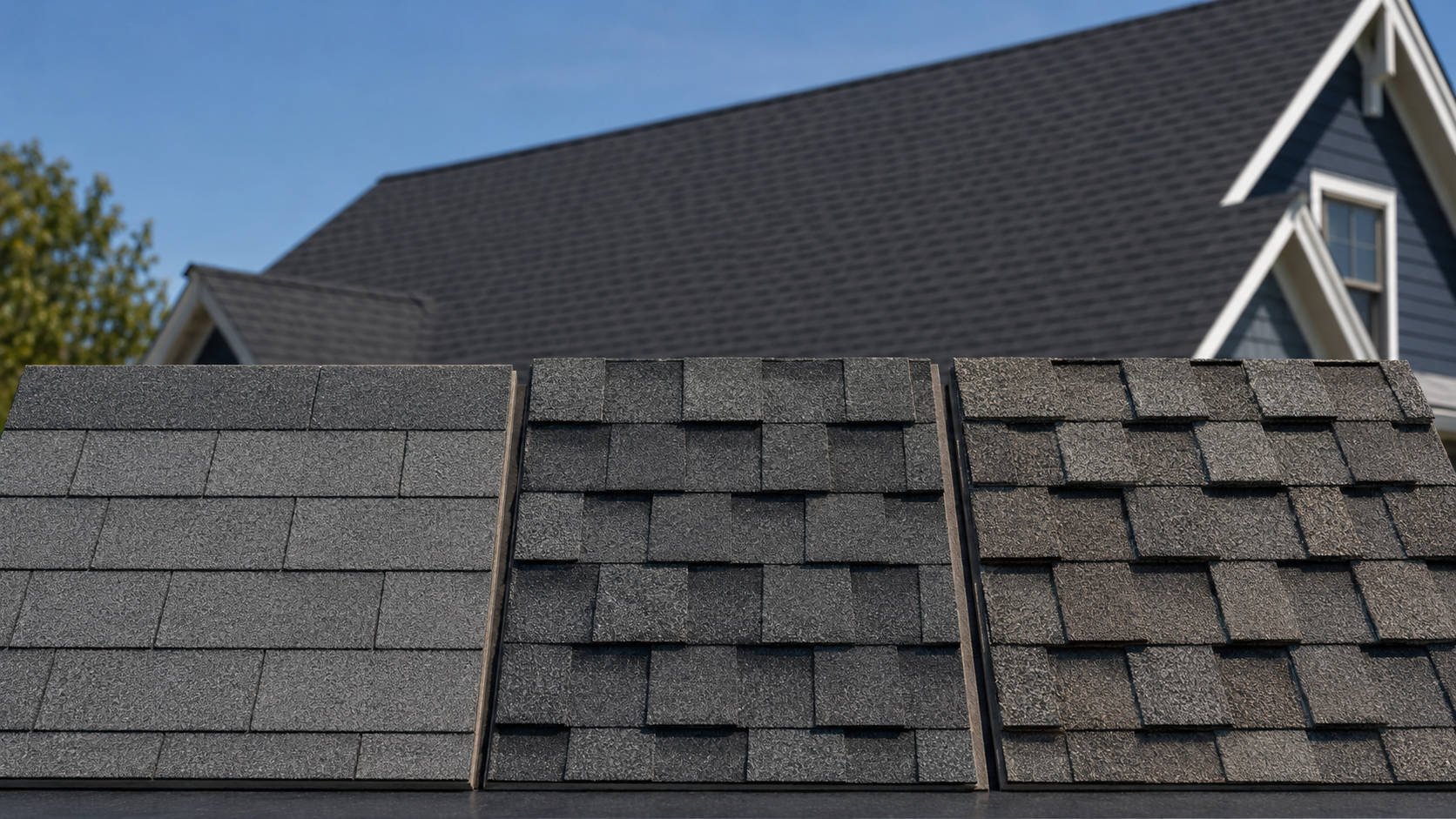
3-tab shingles have a flatter, more uniform profile. Architectural shingles use laminated construction to create more dimension. Performance shingles are usually architectural shingles with added features or tested ratings for concerns such as wind or impact. These categories can overlap, so compare the exact manufacturer, product line, ratings, warranty terms and complete roof system—not the label alone.
Choosing shingles can sound simple until several product names begin describing different things. One term refers to shape. Another describes construction. A third may describe tested performance.
That is why a clean “good, better, best” ladder can be misleading. A performance shingle may also be an architectural shingle. Two products in the same category may carry different ratings, fastening details, warranty terms and installation requirements.
Profile
Do you prefer a uniform roof plane or a deeper, dimensional appearance?
Exposure
Which wind, hail, algae and weather conditions matter at the property?
Specification
What exact product, roof-system components and warranty terms are included?
The comparison rule
Category names narrow the options; product documents decide the comparison. Ask for the manufacturer and product line, then review the ratings, warranty, required installation method and availability for the home’s location.
3-tab vs. architectural vs. performance shingles at a glance
The table below compares the categories in practical terms. “Performance” is not one universal industry grade, and it does not replace the architectural category. It describes products built or tested for particular performance characteristics.
| Comparison | 3-tab | Architectural | Performance |
|---|---|---|---|
| Typical construction | Single-layer appearance with evenly cut tabs | Laminated sections create a dimensional profile | Often laminated architectural construction with added features |
| Appearance | Flat and uniform | Dimensional with varied shadow lines | Usually dimensional; colors and profiles vary by line |
| Weather-related features | Product-specific; verify all ratings | Product-specific; broader feature range is common | May add reinforced fastening, impact classifications or other tested features |
| Relative starting price | Often lower | Often mid-range | Often higher because of added product features |
| Best use of the label | Describe the uniform shingle format | Describe laminated, dimensional construction | Signal that specific enhanced features deserve closer review |
Relative price can vary with the roof, region, product availability, labor, tear-off scope and complete system. A shingle-only price does not represent the installed roof.
What are 3-tab shingles?
Three-tab shingles are asphalt shingles cut to create three evenly sized tabs along the exposed lower edge. Once installed, the repeated pattern creates a flatter, more uniform roof plane.
Their simpler construction has historically made 3-tab products a lower-initial-price option. That does not mean every 3-tab shingle has the same wind rating, warranty or expected service life. Those details still belong to the exact product and installation.
3-tab may fit when
The homeowner wants a simple, uniform appearance and the exact product meets the project requirements.
Availability matters. Some contractors and markets have moved toward laminated shingles as the standard residential choice, so do not assume a 3-tab product is offered merely because the category exists.
What are architectural shingles?
Architectural shingles—also called dimensional or laminated shingles—use layered construction to create varied shapes, shadow lines and a deeper roof profile. The finished surface can resemble the visual depth of wood shakes while retaining asphalt-shingle construction.
Architectural is a broad category, not one performance level. An entry-level laminated shingle and a reinforced performance shingle can both be architectural. Their wind classifications, impact classifications, algae protection, fastening zones, colors and warranty terms may still differ.
Trinity’s current shingle selection guide identifies IKO Cambridge as its architectural option. Cambridge is positioned around dependable laminated construction, classic style and value. Homeowners should still review the specific color availability, warranty documents and full installation scope supplied with the proposal.
What are performance shingles?
Performance shingles are built or tested around enhanced characteristics such as wind resistance, impact resistance or fastening strength. Because “performance” is not one universal rating, the homeowner must identify which feature has been added and what the supporting standard or warranty actually says.
Trinity’s current performance option is IKO Dynasty, a laminated architectural shingle with a reinforced ArmourZone® nailing surface. IKO lists Dynasty with ASTM Class F and Class H wind-resistance standards, a Class A fire-resistance classification and a Class 3 impact-resistance rating. IKO also states that its limited wind-resistance warranty can reach 130 mph when the product is installed according to the applicable requirements.
01
Reinforced fastening
A wider reinforced nailing area is designed to improve fastening placement and resistance to nail pull-through.
02
Wind documentation
A wind-related claim should point to the product standard, installation instructions and limited warranty conditions.
03
Impact classification
An impact rating describes performance in a standardized test. It does not make the roof hail-proof.
04
Appearance options
Enhanced construction does not remove the design decision. Compare available blends against the home’s siding, masonry and trim.
Impact-resistant does not mean impact-proof
IKO states that its impact classification may support an insurance-premium reduction where available, but it is not a guarantee against hail damage, and hail damage is not covered by the manufacturer’s limited warranty. Ask the insurer whether any credit applies to the home and product before treating it as part of the financial decision.
Compare Trinity shingle options
See architectural and performance choices for the home
Review Trinity’s current IKO Cambridge and Dynasty options, available color blends and system details before selecting a roof.
Which shingle factors should carry the decision?
Start with the property and the roof, then compare products. A more expensive feature creates value only when it addresses a real priority or risk.
| Decision factor | What to evaluate | What to request |
|---|---|---|
| Local weather | Wind exposure, hail history, temperature swings, snow and moisture | Relevant product standards and installation requirements |
| Roof design | Pitch, valleys, penetrations, ventilation and edge exposure | A complete roof-system specification—not a shingle-only quote |
| Appearance | Profile, color variation and relationship to siding, masonry and trim | Physical samples and a digital roof visualization where available |
| Time horizon | How long the homeowner expects to keep the property and which features matter during that period | Product-specific warranty and transfer terms |
| Budget | Installed project price, not only bundle or material cost | Side-by-side proposals with the same removal and system scope |
If two options exceed the home’s actual needs in the same way, added features may not justify the price difference. If one product directly addresses a documented weather exposure or aesthetic priority, the upgrade may be easier to defend.
Why installation and the full roof system matter as much as the shingle
A tested shingle can only perform as part of a properly prepared and installed assembly. Deck condition, underlayment, ice-and-water protection, starter components, flashing, ventilation, ridge materials, fastener placement and local code requirements all affect the result.
Manufacturer warranties also contain application requirements, limitations and exclusions. Product coverage generally does not substitute for workmanship coverage. Review Trinity’s roofing warranty framework, then compare the actual manufacturer and craftsmanship documents included with the proposal.
Product
Exact shingle line, accessory products, ratings, colors and manufacturer terms.
System
Deck, water-management layers, flashing, ventilation and roof-specific details.
Workmanship
Installation process, supervision, final inspection and responsibility after completion.
Use the roofing estimate checklist to compare those layers across proposals. Trinity’s roof replacement service also outlines the components included in its installation process.
Five questions to ask before choosing shingles
01
What exact product is this?
Record the manufacturer, line, color and accessory products rather than accepting a generic category.
02
Which feature fits this home?
Ask what roof condition, weather exposure or design goal supports the recommendation.
03
What does the rating mean?
Identify the test standard, warranty conditions and limits behind wind, impact, fire or algae language.
04
What does the warranty cover?
Separate manufacturing defects, wind terms, algae terms and workmanship responsibility.
05
What changes with the upgrade?
Compare the feature, installed price and practical value—not just a more premium product name.
The best shingle is the one the home can justify
Three-tab, architectural and performance labels are useful starting points. They are not substitutes for a roof-specific recommendation.
A defensible decision connects the home’s exposure, roof design, appearance goals, time horizon and budget to one exact product and a complete installation plan. The contractor should be able to explain why the selected feature matters, what standard supports it and what the warranty does—and does not—cover.
Choose with the roof in view
Compare shingle options for the home—not in isolation
A Trinity Roofing Expert can assess the roof, explain the available IKO architectural and performance options and connect the recommendation to the complete replacement scope.
Continue learning